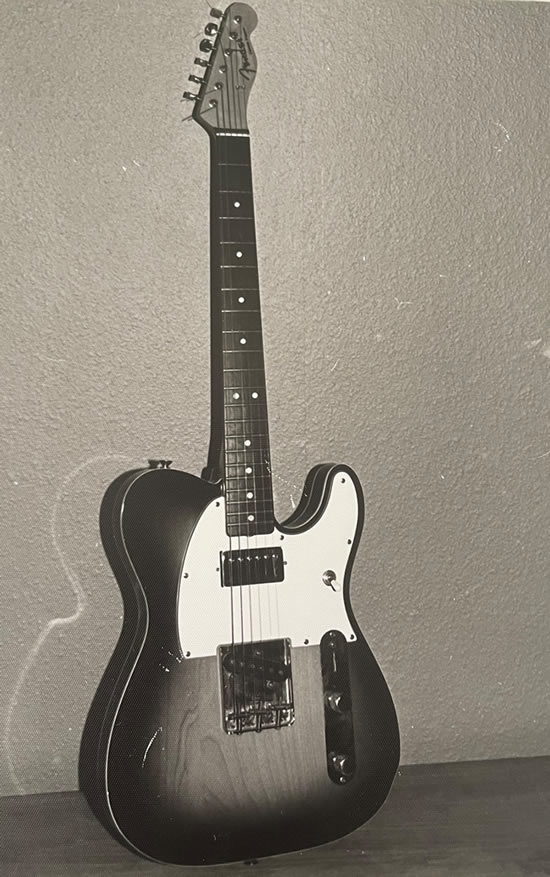
One of my instruments, namely my Fender electric guitar, has recently been handed in to Chris McIntyre at mcintyreguitars.com for repairs. It is a 1963 Esquire, but had some mods done before I got my hands on it, including a humbucker pickup fitted on the neck side of the guitar (rather than one pickup as you would originally find), while one of my musician friends fitted an out of phase unit, including switch.
I’ve played the guitar for years and it’s been well gigged (although not so much these days) and was in need of some maintenance. The guitar is needing re-fretting as the original frets have been well worn. The pots are also noisy, so Chris is going to investigate this and may end up fitting a new neck pickup, as well as some new wiring and shielding, but we’ll see.
The Esquire came into my possession through me coming across an advert in the Edinburgh Evening News sellers column. The guitar was advertised for £200, which around the late 1970s was a lot of money for me at the time! But after scrapping money from here and there, plus a small loan from my relatives, I answered the ad.
If I can recall correctly, after speaking to the guy who was selling it, he came round to my flat in Robertson Avenue, Edinburgh with the guitar. He was selling it on behalf of his brother who lived in Dundee and the reason for the sale was his brother needed funds to further his education and it has been in my possession ever since.
A little on the genesis of this guitar. It is a solid body electric guitar made by Leo Fender and George Fullerton and in terms of shape they must have got it right first time, as it has never altered from 1949-1950 when they built the first prototype.
The first Esquires were manufactured in the 1950s with one pickup fitted to the bridge position, one tone control and one volume control, fitted with a three-way selector switch to give different flavours of sound. The first pickups fitted on the Esquire, where from Fender’s champion lap steel guitars.
With individual pole pieces for each string mounted at a slant there was only three bridge saddles fitted, this allows for individual adjustment of string height, and intonation adjustment in pairs only.
The neck on the first Esquires were made of maple wood without a separate fret board, or truss rod the head had three tuners fitted on each side, the body was made of pinewood this was the prototype, to what was to come in later years.